catacomms
A dungeon for a few friends, played over radio you own. Your party is whoever you can hear.
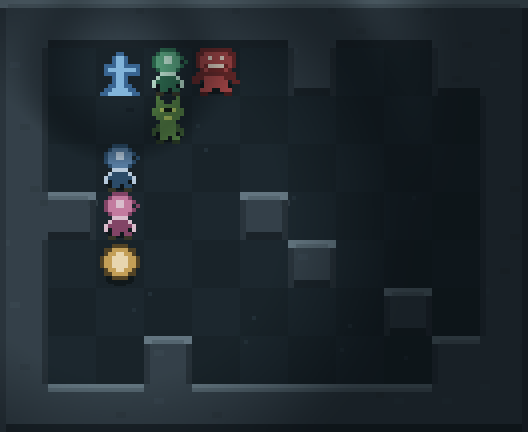
What it is
One to four people plug a LoRa module into a USB port, go down together, and come back out or do not. No server, no account, no internet.
It runs on loraline, the messenger the radios were already doing: same modules, same keys, same link. Anything you type that is not a command is said out loud to the party.
Turn-based, because the radio says so
The European duty cycle allows one percent, so every millisecond transmitted owes a hundred of silence. A turn costs about 185 ms a player, which is one action every eighteen seconds.
A loot-and-repeat loop is fun because it is dense. At eighteen seconds a swing it is not slower, it is worse. So this is an expedition. You go in as a party, it is dangerous, and eighteen seconds to choose is deliberation rather than lag. A room runs about sixteen turns.
Actions have a length: a swing is one tick, cutting a tree is sixty. Airtime is charged per transmission rather than per second of game time, so fighting is expensive and working is nearly free.
Your party is whoever you can hear
Every online game simulates distance, and every one can be lied to, because your machine reports where it is. Here your position is measured by other people's receivers. Whether you can be heard is a fact about buildings and hills.
The fog of war is a wall.
How the machines agree
The engine is deterministic. A room and everyone's inputs go in, the next room comes out: no clock, no floats, no randomness that is not derived from the turn number. Same inputs, same bytes, on every machine.
The radio loses packets, so a turn waits until every player who is due has spoken, and loraline retransmits until acknowledged. Everyone then publishes an eight-byte hash of the result, and a disagreement shows up at once.
That is detection, not consensus. Three players on a half-duplex channel have no quorum worth having, and for a party who can see each other it is enough: the game stops and says so rather than drifting into two worlds.
Everything is in that hash. What you carry, whether the shrine is spent, how many came down. A client that gave itself a better sword is not cheating anyone, it is playing a different game, and everyone finds out next turn.
What a delve leaves behind
A room is a pure function of its seed and roster, so anyone can rebuild it and confirm an Ashen Fang is what drops there. What they cannot check alone is that you walked out with it.
So when a room ends, everyone present builds the same record and signs it. Only the signature crosses the radio. Editing what you carried out invalidates every signature at once.
You cannot witness your own loot. A delve alone is signed only by you, and mints nothing.
Being reachable is not being somewhere. The record notes whether each person was heard on air. A delve played over the internet is witnessed and still mints nothing. In a mixed party the people who were there earn, and the one on a socket does not.
Each node serves a board of what it witnessed. There is no central one. Your browser recomputes each address from the two public keys and verifies every signature before counting anything.
What you find
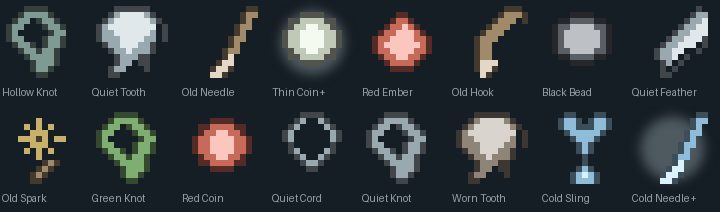
| kind | plain | fine | rare | named | |
|---|---|---|---|---|---|
| blade | one square | 6 | 8 | 10 | 12 |
| bow | four squares | 3 | 5 | 7 | 9 |
| rod | three, always lands | 2 | 4 | 6 | 8 |
| armour | chance to be missed | 20% | 30% | 40% | 50% |
| charm | maximum health | +4 | +7 | +10 | +13 |
Nothing is equipped. You strike with whatever reaches, and with the harder one when two do. Armour is a chance to be missed, so it turns a blade or an arrow but never a rod.
The first thing in the line is the thing you hit. A friend between you and the ogre is a friend you do not shoot.
rare turns up in one room in seventeen, named in one in twenty-six. A named blade doubles your damage; a named coat means half of everything swung at you misses.
Coin pays a shrine, two for a point of health, and sixty percent of rooms have one. The thing you came down for is the thing that keeps you alive long enough to carry it out.
How far down
/delve 3 2 is depth three carrying two torches. Deeper rooms are
bigger, hold more and hold worse. Four hundred rooms at each setting, three
players:
| depth | torches | cleared | withdrew | wiped |
|---|---|---|---|---|
| 1 | 0 | 61% | 27% | 11% |
| 1 | 2 | 68% | 19% | 12% |
| 3 | 0 | 24% | 49% | 26% |
| 3 | 2 | 35% | 26% | 38% |
| 4 | 0 | 20% | 60% | 18% |
| 4 | 2 | 33% | 33% | 33% |
Two torches turn a third of your withdrawals into clears. A third changes nothing, because by then the fight is decided rather than the light.
/camp goes above ground, where there are trees and nothing that
bites. A log is a torch. A cut takes a minute of game time and one frame of
radio, which is long enough to talk over.

The limits
Four people
One monster each, and one more every second step down. Depth one, two torches, four hundred rooms at each size:
| party | cleared | withdrew | wiped | median turns |
|---|---|---|---|---|
| 1 | 67% | 14% | 17% | 9 |
| 2 | 67% | 19% | 13% | 12 |
| 3 | 66% | 22% | 11% | 16 |
| 4 | 69% | 22% | 8% | 18 |
Past four, heartbeats and inputs collide on a channel that carries one at a time.
A room, a camp, and what you carry
There are no towns, no levels and nothing to buy. You delve, you cut wood, you carry things out. That is the game.
The band is yours to get right
It transmits on licence-free spectrum that differs by country. Read loraline's setup first.
Playing
catacomms is inside the loraline app, not a separate program. One download, one radio, one setup: chat and the dungeon are the same thing running, which they have to be, because a serial port can only be opened once and the game has chat in it.
Two minutes to your first delve with nothing but a laptop. Going down alone needs nobody to talk to, so it needs no radio.
Play catacomms From an empty computer to a room full of monsters.Its opposite
longshore runs on the same radio and is built the other way round: a coast, some fish, nothing at stake, and nobody racing anybody. Hours rather than minutes.